A routine blood-group visit usually involves identity checks, a small venous blood draw, laboratory testing and a report showing your ABO and RhD type. You will know what to bring, what the technician does, how the result is verified and when a simple blood-group test is not enough for transfusion or clinical care.
Key takeaways
- You do not need fasting for a standalone ABO/RhD blood group test.
- Carry a valid ID and check that your name matches the request form.
- Ask when your report will be ready and how rejected samples are handled.
- An ABO/RhD report does not diagnose anaemia, infection or other health conditions.
Before the blood draw: booking, preparation and identification
A standalone ABO/RhD blood group test generally needs no fasting, medicine stoppage or special dietary preparation. Eat and drink normally unless another test on the same request form has different instructions.
1. Before leaving, confirm the centre’s collection hours and whether you need an appointment. Requirements differ across Delhi centres, so anyone searching “blood group test near me” should also ask which identification documents are accepted and whether a doctor’s request is required.
2. Tell the centre before collection if you take anticoagulants, have difficult veins or have fainted during an earlier blood draw. Do not stop an anticoagulant for this test unless the clinician managing it instructs you to do so.
3. At registration, staff record the blood group test request, verify your name and check a second identifier, such as your date of birth or phone number. They compare the request form with these details before sending you for collection.
This matching protects you from a serious reporting error. A laboratory can test a tube correctly, but the result is unsafe to report if that tube belongs to the wrong person.
If you are arranging a blood type test in Delhi alongside surgery, pregnancy care or transfusion planning, ask whether additional testing is included. A routine ABO/RhD test alone does not cover every compatibility requirement.
How the sample is collected and labelled
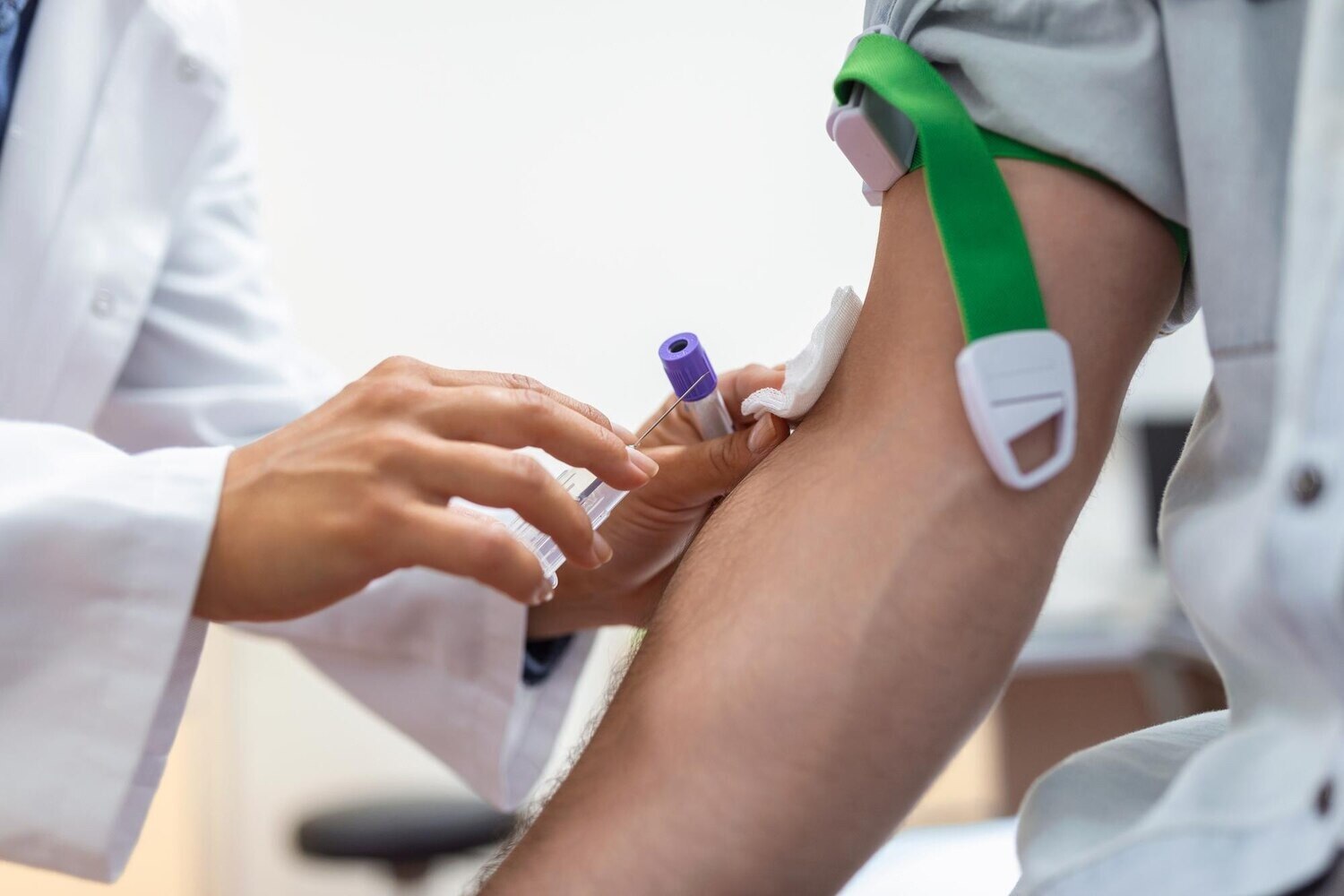
Adults normally provide a venous blood sample from a vein in the arm, usually collected into an EDTA tube. A finger-prick is not the routine adult method when the laboratory needs a standard sample for the blood group test procedure in Delhi.
At the collection chair, the sequence is:
- The phlebotomist rechecks your name, another identifier and the test request.
- A tourniquet is applied, and a suitable vein is selected.
- The puncture site is cleaned with antiseptic and allowed to dry.
- A sterile needle is inserted, and the EDTA tube is filled.
- The needle is removed, and pressure is applied with gauze.
- The tube is labelled in your presence and sent to the laboratory.
The draw usually takes only a few minutes. Expect brief needle pain; bruising or light-headedness can follow, while prolonged bleeding or infection is uncommon.
Children may need a smaller-volume collection suited to their size. Newborns and very young infants require an age-appropriate specimen and interpretation, because applying the adult procedure unchanged can produce misleading results.
Their ABO antibodies may not yet be reliably developed, so red-cell testing and clinical context carry greater weight when deciding how blood grouping is done.
How the laboratory determines ABO and RhD
The laboratory begins with forward grouping: it mixes the patient’s red cells separately with anti-A and anti-B reagents. Visible agglutination, or clumping, shows that the matching A or B antigen is present. That is how blood grouping is done in practice; it identifies ABO antigens, not overall health.
| ABO type | Forward grouping | Reverse grouping |
|---|---|---|
| A | Anti-A clumps; anti-B does not | Plasma reacts with B cells, not A1 cells |
| B | Anti-B clumps; anti-A does not | Plasma reacts with A1 cells, not B cells |
| AB | Both anti-A and anti-B clump | Plasma does not react with A1 or B cells |
| O | Neither reagent clumps | Plasma reacts with both A1 and B cells |
Reverse grouping confirms the result by testing the patient’s plasma against known A1 and B reagent cells. Forward and reverse findings should agree. If they do not, the laboratory records an ABO discrepancy and investigates it rather than automatically reporting A, B, AB or O.
RhD testing mixes the red cells with anti-D reagent. A detectable reaction is reported as Rh-positive; no detectable D antigen is generally reported as Rh-negative. Weak or variant D reactions can require additional testing.
Manual tube, slide, microcolumn-gel and automated analyser workflows all detect agglutination, but differ in sensitivity and workflow. The laboratory uses appropriate controls and resolves unexpected reactions before issuing the result.
What the report means—and what it cannot answer
A final report commonly states “ABO: A; RhD: positive” or “ABO: O; RhD: negative.” It may also name the specimen, such as EDTA whole blood, and the method, such as tube, gel-column or automated testing. “Discrepancy” or “weak D” means the laboratory needs further investigation.
ABO/RhD typing does not diagnose anaemia, infection, diabetes, immunity or general health. A blood type test in Delhi is not a transfusion crossmatch: before transfusion, a hospital may require an antibody screen plus a serological or electronic crossmatch against a specific donor unit.
Surgery, pregnancy care and transfusion planning can require more than routine typing. Ask whether the clinician or transfusion service has requested:
- An antibody screen to detect unexpected red-cell antibodies.
- Extended red-cell antigen testing or phenotyping when clinically indicated.
- Compatibility testing against the intended donor unit.
Tell the laboratory about recent transfusion, stem-cell transplantation, pregnancy or monoclonal-antibody treatment. These details can produce mixed-field or unusual reactions, so the laboratory may need an extended work-up instead of issuing a routine result.
Newborn reverse grouping can be weak or uninterpretable because infants have not reliably developed their own ABO antibodies. Red-cell testing and clinical context therefore carry more weight than applying the adult interpretation unchanged. A reported blood type remains one laboratory finding, not proof that blood is safe to transfuse without current compatibility testing.
Report timing, rejected samples and choosing a centre
Ordinary blood-group testing is often reported the same day or within one working day, but confirm the centre’s own reporting time before collection. Urgent reporting can alter scheduling; it must not bypass investigation of an unclear result.
A laboratory may reject or repeat a specimen when it is:
- Clotted
- Haemolysed
- Underfilled
- Incorrectly labelled
- Inconsistent with the request form
- Beyond its stability limit
An ABO discrepancy, weak D investigation, repeat collection or referral to a reference laboratory can delay the report. A rapid-report promise does not make an unresolved finding safe to issue.
If you search “what happens during blood group for testing in delhi” or “blood group test near me,” compare centres using these checks:
| Check | Suitable evidence | Why it matters |
|---|---|---|
| Parent laboratory | NABL-accredited for the relevant medical-testing scope | Proximity alone does not establish quality |
| Report content | Specimen, method, ABO type, RhD finding and qualifications such as “discrepancy” or “weak D” | Missing details make clinical review harder |
| Local centre | Clearly identified samples and documented transfer to the parent laboratory | Prevents identity and traceability errors |
| Clinical fit | Report format matches the clinician’s request | A routine type is not a crossmatch |
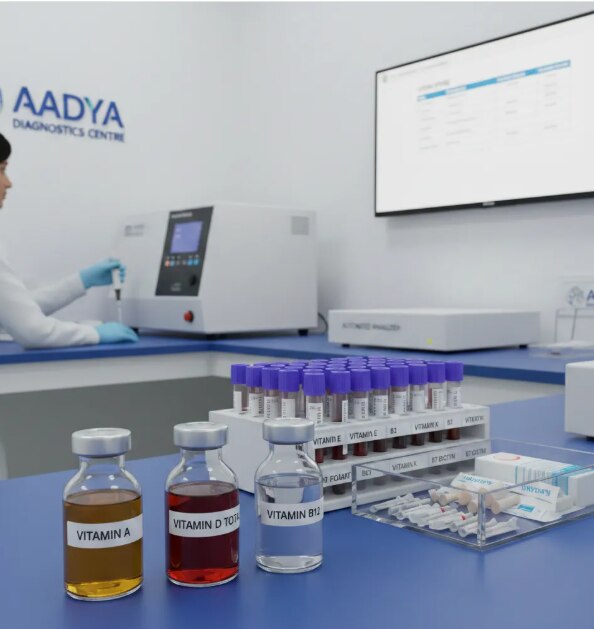
Aadya Diagnostics Centre can be considered alongside other Delhi centres that provide this documentation and reporting detail. A transfusion decision requires laboratory confirmation from an appropriately identified specimen; a self-reported blood type is not a substitute.
Related service
BLOOD GROUP At Aadya Diagnostics Centre, our Blood Grouping and Rh Typing service is a fundamental diagnostic essential for every individual's medical records. View service → |
Frequently asked questions
Do I need to fast before a blood group test in Delhi?
No. A standalone ABO/RhD blood group test generally needs no fasting, medicine stoppage or special dietary preparation. Follow different instructions if other tests appear on the same request form.
How is blood grouping done?
A laboratory tests your red blood cells with anti-A, anti-B and anti-D reagents, then checks the reaction pattern to determine your ABO group and RhD status. The laboratory may also test the plasma as a confirmation step.
What should I check before the blood sample is collected?
Confirm your name, date of birth and test request with the collector. Bring identification if the centre requires it, and check that the tube label matches your details before leaving.
What does an ABO/RhD blood group report tell me?
It identifies your ABO group—A, B, AB or O—and whether your RhD status is positive or negative. It does not diagnose anaemia, infection, diabetes or other medical conditions.
Why might a blood group sample be rejected?
A centre can reject a sample when the tube is unlabeled, has mismatched patient details, contains too little blood, is clotted when it should not be, or is damaged during transport. Ask whether recollection is required.
Keywords