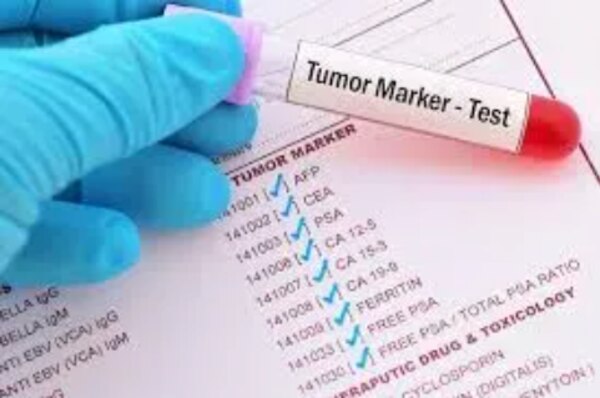
A “cancer marker test” is not one standard investigation: PSA, CA-125, CEA, AFP, CA 19-9, beta-hCG and breast-related markers answer different clinical questions. By the end, you will know which markers relate to common health concerns, when blood testing is useful, and when imaging, biopsy or another medical assessment is the better first step.
Key takeaways
- A raised tumour marker does not prove cancer.
- A normal marker result does not rule out cancer.
- Match each marker to the suspected cancer and clinical question.
- Ask your doctor when imaging or biopsy is the better first step.
What a cancer marker blood test can—and cannot—show
Choosing a cancer marker test in Delhi for screening, diagnosis or follow-up depends on the clinical question. Tumour markers are substances measured in blood, but most are not reliable stand-alone screening tests for people without symptoms. A raised result does not prove cancer, and a normal result does not rule it out.
Non-cancer causes can change results. Infection, inflammation, smoking, pregnancy, menstruation, liver disease, prostatitis and bile-duct obstruction can all produce misleading values. Some cancers also release little or no measurable marker.
Doctors interpret a result alongside your symptoms, physical examination, imaging and, when needed, a biopsy. One isolated number rarely answers the question.
| Test type | What it measures | What it can and cannot show |
|---|---|---|
| Serum tumour marker | A substance such as PSA, CEA or CA 19-9 in blood | Supports selected diagnostic or monitoring questions; it is not a universal cancer screen |
| Tissue biomarker | Features in tumour cells, including HER2, oestrogen receptor and progesterone receptor | Requires tumour tissue from a biopsy or surgery and can guide targeted or endocrine treatment |
| Circulating-tumour-DNA or liquid biopsy | Tumour-derived genetic material in blood | Answers narrower questions, such as selected mutations or treatment monitoring; it is not interchangeable with a routine marker assay |
A tissue result cannot be substituted with a blood marker. Likewise, a negative liquid-biopsy result can reflect too little tumour DNA and does not automatically exclude cancer.
Which marker matches each health concern?
The phrase cancer marker blood test in Delhi covers different assays, not one universal panel. Match the test to the clinical question:
| Concern | Marker or test | What it means |
|---|---|---|
| Suspected prostate disease | PSA | Benign enlargement, prostatitis, urinary infection, ejaculation and recent prostate procedures can raise PSA. A raised result needs clinical review, repeat testing or further evaluation; it does not prove cancer. |
| Breast-cancer follow-up | CA 15-3 or CA 27.29 | These markers suit selected monitoring situations. HER2, oestrogen receptor and progesterone receptor testing usually requires tumour tissue from a biopsy or surgical specimen. |
| Ovarian or pelvic concern | CA-125 | It is not a general screening test for average-risk, asymptomatic women. Menstruation, pregnancy, endometriosis and other conditions can raise it. |
| Pancreatic or biliary concern | CA 19-9 | Obstruction, cholangitis and pancreatitis can increase it. Some people do not produce CA 19-9, so a normal result cannot exclude disease. |
| Colorectal-cancer follow-up | CEA | Smoking and benign disease can elevate CEA, so doctors interpret it against earlier results and other findings. |
| Liver-mass evaluation | AFP plus liver ultrasound | AFP gains meaning from ultrasound and risks such as cirrhosis or chronic hepatitis B. |
| Testicular or germ-cell tumour | Beta-hCG and AFP | These markers can support evaluation, but non-cancer conditions affect results; pregnancy also produces beta-hCG. |
| Thyroid concern | Examination, TSH and ultrasound | Assessment usually starts here, not with a generic tumour-marker panel. |
Each result answers a narrower question. Choose the specific assay a clinician can interpret rather than ordering every available marker.
When doctors use tumour markers after diagnosis or treatment
Serial testing answers a treatment or follow-up question; one result ordered for reassurance usually cannot. After diagnosis, a doctor compares the new value with earlier results to assess response or watch for recurrence. The comparison is strongest when the same laboratory, assay method, units and reference interval are used.
| Marker | Common follow-up use |
|---|---|
| CEA | Colorectal and selected other cancers |
| PSA | Prostate cancer monitoring |
| CA 19-9 | Pancreatic or biliary cancer monitoring |
| AFP | Liver or germ-cell tumour monitoring |
| CA-125 | Selected ovarian-cancer follow-up |
| CA 15-3 or CA 27.29 | Selected breast-cancer follow-up |
| Beta-hCG and AFP | Germ-cell tumour monitoring |
A changing marker still needs correlation with symptoms, examination, imaging and, when indicated, biopsy. A rise does not identify recurrence by itself.
For people at high risk of hepatocellular carcinoma, including some patients with cirrhosis or chronic hepatitis B, surveillance generally pairs AFP with liver ultrasound at about six-month intervals. AFP alone is insufficient.
Treatment choices can depend on imaging or tissue biomarkers such as HER2, oestrogen receptor and progesterone receptor, not the blood-marker level.
Repeated testing without a defined clinical question creates false alarms. It can lead to overdiagnosis, unnecessary biopsies and treatment for a result that does not represent active cancer. Ask what decision the next measurement will change before ordering it.
How to choose and book the right test in Delhi
Before booking a tumor marker test in Delhi, confirm exactly what question the test is meant to answer. “Cancer marker test” can refer to PSA, CEA, CA-125, CA 19-9, AFP or another assay, not one standard investigation.
Ask the laboratory for:
- Exact analyte and specimen type, such as serum or plasma
- Testing method or assay platform
- Reporting units and the laboratory’s reference interval
- Turnaround time and how the report will be delivered
- Whether the result supports screening, diagnosis or treatment monitoring
- Whether a doctor’s prescription or referral is required
- Whether fasting, medication restrictions or other preparation applies
| Choice | Best use | Main caution |
|---|---|---|
| Single marker | A defined clinical question, such as PSA or CEA monitoring | It cannot assess every possible cancer |
| Marker panel | Several clinician-defined questions requiring separate assays | More abnormal or confusing results can lead to unnecessary follow-up |
Ask whether one marker is more appropriate than a panel. A broad panel is not a shortcut to certainty.
NABL accreditation is laboratory- and scope-specific. A facility’s accreditation does not automatically cover every advertised assay, so ask whether the selected test falls within the laboratory’s relevant accredited scope.
For monitoring, use the same laboratory and method where possible. Do not compare results casually across platforms: calibration, units and reference intervals can differ, and even a genuine change needs clinical and imaging correlation.
At Aadya Diagnostics Centre, confirm these operational details before booking and ask whether the selected assay is processed under its relevant accredited scope.
Related service
CANCER MARKERS The Cancer Marker Profile at Aadya Diagnostics Centre is a vital diagnostic tool designed for the early detection and monitoring of various... View service → |
When a marker test is the wrong first step
Unexplained weight loss, persistent bleeding, a new lump, jaundice, a persistent change in bowel habits or a testicular mass calls for medical assessment—not a self-ordered bundle of tumour markers. A marker can distract from the test that identifies the problem, while a normal result can falsely reassure you.
1. Start with clinical examination and routine laboratory tests. Blood counts, liver-function tests, kidney function and urinalysis can identify anaemia, infection, organ injury or other clues.
2. Use imaging for a structural concern: ultrasound, mammography, CT or MRI can show where a mass, obstruction or organ abnormality is located.
3. Choose endoscopy for persistent gastrointestinal bleeding or bowel changes. It lets the clinician inspect the lining and sample suspicious areas.
4. Use biopsy when tissue confirmation is needed. Pathology can establish whether abnormal tissue is cancer and identify features that guide treatment.
A doctor may order a marker alongside these investigations, not instead of them. For a man without symptoms considering PSA, discuss the trade-off individually: false positives can lead to biopsy complications; detecting slow-growing cancer can cause overdiagnosis and overtreatment. Age, family history and personal preferences belong in that decision.
Order a specific marker only when there is a defined clinical question and a clinician who can interpret the result in context.
Frequently asked questions
What can a cancer marker blood test show?
It measures substances linked with certain cancers, but most tumour markers cannot confirm or exclude cancer on their own. Doctors interpret results with symptoms, examination, imaging and sometimes biopsy.
Which tumour marker matches each health concern?
The appropriate marker depends on the suspected cancer and the clinical question. Examples include PSA for prostate concerns, CA-125 for selected ovarian evaluations, CEA for monitoring some colorectal cancers and AFP for selected liver or testicular evaluations.
When are tumour markers used after diagnosis or treatment?
Doctors may use a marker to establish a baseline, assess response to treatment, monitor disease over time or investigate recurrence alongside imaging and examination.
When is a tumour marker test the wrong first step?
It is usually the wrong first step for people without symptoms who want general cancer screening. It is also insufficient when a symptom requires examination, imaging or tissue biopsy.
How do you choose and book a cancer marker test in Delhi?
Start with the suspected condition and your doctor’s written test request. Confirm the exact marker, sample requirements, preparation, reporting time and whether the laboratory provides a doctor-reviewed interpretation.
Keywords